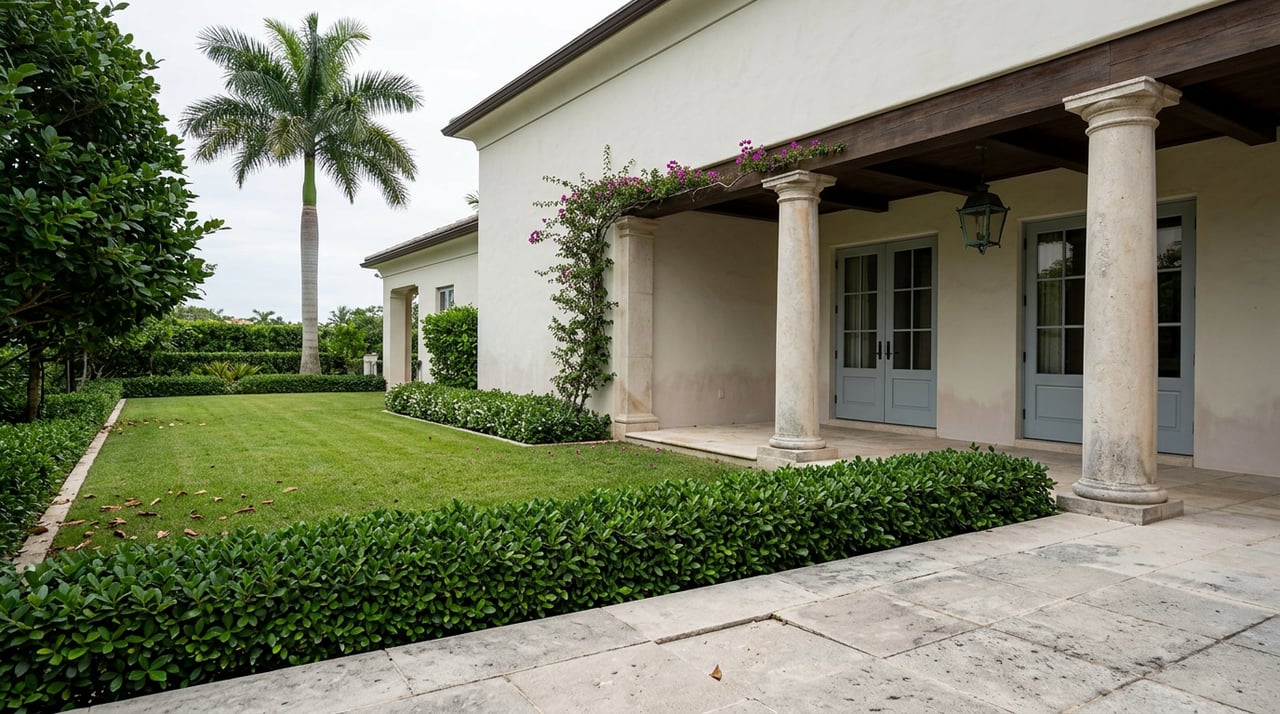
A homeowner in a 1950s bungalow near Swinton Avenue wants a simple four-foot picket fence for the front yard. Before a contractor can pull a building permit, the plan has to clear the city's Historic Preservation Board for material, color and style. A few blocks west in Lake Ida, a similar CBS home on the water wants a six-foot masonry wall along the back property line. No design board weighs in on the look of that wall at all. Instead an engineer has to calculate wind uplift at 165 miles per hour and the FEMA AE flood zone dictates how the wall handles drainage.
Same city. Same kind of project. Two completely different approval paths. The variable isn't the house's age, its price, or even its construction type. It's whether the parcel sits inside one of five specific boundaries the city drew decades ago, boundaries that never show up on a listing sheet and rarely come up until a buyer is already deep into renovation plans.
The Line Nobody Draws on a Listing Sheet
Delray Beach adopted its Historic Preservation Ordinance in March 1987, and that ordinance created the seven-member Historic Preservation Board that still administers it today. Under the city's own definition, a property counts as historic if it's at least fifty years old and carries significance for its history or architecture. That's a broad definition, and on its own it would apply to a lot of Delray Beach housing stock.
What actually triggers board review is narrower and more mechanical: does the parcel fall inside one of the city's five locally registered historic districts. If it does, exterior work gets a layer of design review that a nearly identical house one street over will never see. If it doesn't, the project moves through the standard building department process like any other renovation in Palm Beach County.
That single fact, inside the line or outside it, is the real hinge for anyone comparing two similar fixer-uppers in Delray Beach. Price per square foot tells you what the house costs. The boundary tells you how long the renovation will take and what you're allowed to touch without asking permission first.
Five Boundaries, Five Different Neighborhoods
The five districts aren't interchangeable, and each one carries its own texture:
- Old School Square Historic Arts District, the city's largest, with 176 structures and 101 counted as contributing. It sits at the original footprint of the town's settlement and includes Banker's Row.
- Del-Ida Park, platted in 1923 and designated in 1988, covering 58 acres and 151 structures, 47 of them contributing Mediterranean Revival and Craftsman Bungalow buildings laid out on a distinctive diagonal street grid.
- Marina Historic District, wrapped around the City Marina on the Intracoastal Waterway, mixing Streamline Moderne, Colonial Revival, Mediterranean Revival and Bungalow styles along narrow, shaded streets.
- Nassau Park, the only historic district east of the Intracoastal, made up of just seventeen Cape Cod Colonial Revival cottages from the 1930s.
- West Settlers Historic District, added in 1997 and tied to the city's first African American settlement dating to 1894, home to sites like the Spady Cultural Complex.
Two of these districts also carry National Register status, which matters later when we get to the money side of this. But for renovation purposes, local designation is what pulls a project into board review, not the national listing.
What Actually Needs a Board's Sign-Off
The trigger points are specific, and they surprise people who assume historic review only applies to additions or teardowns.
| Action | Outside any historic district | Contributing structure in a district | Non-contributing structure in a district |
|---|---|---|---|
| Exterior paint color | No review | Certificate of Appropriateness required | Certificate of Appropriateness required |
| New or replacement fence | Standard permit | HPB review for material, height, style | HPB compatibility review still applies |
| Demolition | Standard permit process | COA required before any permit issues | COA required, same as contributing |
| Addition or major exterior remodel | Standard permit | COA review of massing and materials | COA review, generally more flexible |
The paint line is the one that catches people off guard most often. Changing an exterior color on a historic property requires an approved Certificate of Appropriateness and a Building Materials and Color Sample Form, according to the city's own historic preservation guidance. It isn't a suggestion. A homeowner who repaints without that approval can be asked to repaint again in a compliant color.
The demolition line matters just as much for anyone eyeing a teardown-and-rebuild lot. Inside a historic district, demolition of a structure, contributing or not, requires board review and approval before any building permit for the replacement project can be issued. That single requirement can add months to a timeline that a buyer assumed would move at the pace of a standard demo permit.
The Friction That Doesn't Show Up Until You Pull the Permit
The picket fence story at the top of this piece isn't a hypothetical. A 1950s bungalow inside Old School Square Historic Arts District needing HPB sign-off before a simple front-yard fence goes up is exactly the kind of project that stalls when a homeowner assumes a fence permit is a same-day transaction. Fence work installed without that approval in Old School Square or Nassau Park gets stopped mid-project, and the homeowner has to go back through the board before work resumes.
Outside the historic boundaries, the friction looks completely different but is just as real. That Lake Ida waterfront wall isn't wrestling with a design board, it's wrestling with wind engineering and flood zone rules that apply across most of coastal Palm Beach County regardless of a home's age. And in a non-historic canal community like Tropic Isle, a routine pool-barrier fence swap can turn up an old fence line sitting six inches inside the neighbor's property, forcing a survey and a possible relocation before the pool permit can move forward.
The lesson isn't that historic districts are worse to buy in. It's that every older Delray Beach neighborhood carries its own version of this friction, and the version tied to a historic boundary is a design-review clock that a buyer can actually check before writing an offer, while wind engineering and boundary surveys tend to surface only after a contract is signed.
The Money That Offsets the Slower Clock
The trade for that added review isn't nothing. Delray Beach offers a Historic Property Ad Valorem Tax Exemption for qualifying improvements to designated historic properties, a benefit that doesn't exist for a house one block outside the line. Layered on top of that, federal Historic Tax Credits can cover up to 20 percent of rehabilitation costs for historic properties that are non-owner-occupied and either individually listed or within a Nationally Listed Historic District, which applies to portions of Delray Beach's registered districts.
For an investor or a buyer planning to hold a historic property as a rental, that 20 percent federal credit can meaningfully change the math on a renovation budget that looked expensive on paper. It's the kind of detail that rarely comes up in a listing description but can be the difference between a fixer-upper penciling out and one that doesn't.
Before You Write the Offer
A few questions are worth asking before a renovation budget gets built around assumptions:
- Does the parcel fall inside Old School Square, Del-Ida Park, Marina Historic District, Nassau Park or West Settlers, and is the structure itself listed as contributing or non-contributing
- Does the planned work touch exterior color, fencing, massing or demolition, since those are the categories most likely to require a Certificate of Appropriateness
- Is the property eligible for the local ad valorem exemption or the federal 20 percent credit, and does that eligibility depend on keeping the property non-owner-occupied
- If the lot sits outside any historic district but on the water, has a wind and flood engineering review been priced into the renovation budget separately from any design approval
None of these questions show up on a standard listing sheet. All of them change either the timeline or the budget on a renovation, sometimes both.
A Short FAQ
Does a non-contributing structure inside a historic district still need board review? Yes. Compatibility review applies to non-contributing structures within a designated district, even though the standards can be more flexible than for a contributing building.
Can a homeowner paint a historic Delray Beach house any color they choose? No. Changing an exterior color requires an approved Certificate of Appropriateness and a completed color sample form before the work can proceed.
Does demolition ever get approved inside these five districts? It can, but only after Historic Preservation Board review and approval, and only once a building permit for what replaces the demolished structure has been issued.
Do the tax exemption and federal credit transfer to a new owner? The ad valorem exemption is tied to the property and the qualifying improvements, and the federal credit for non-owner-occupied historic rehabilitation depends on the property continuing to meet that occupancy and listing status, so buyers should verify current terms before assuming either benefit carries forward unchanged.
Whether a property sits inside one of these five lines or just outside them, the difference is real and worth knowing before you fall in love with a floor plan. Engel & Völkers Fort Lauderdale can walk you through what a specific Delray Beach address means for your renovation timeline and budget, historic or not. Contact us to start that conversation before you write the offer.